





As soon as an idea goes into review, every department brings its change requests. Each one sounds reasonable on its own. How much of the idea survives once every request is fulfilled?
In large agency groups, this question is part of daily work.
How big are the big ones?
WPP employed 103,277 people at the end of 2025 according to its annual report. A year earlier the figure was 111,281. The group owns brands such as Ogilvy, VML, and AKQA and operates in more than 100 countries. Publicis of France has overtaken WPP as the world's largest advertising group.
What is happening there right now?
Across 2025 and 2026 the group is shrinking. In July 2025, after losing major clients, WPP cut its annual forecast; the stock fell 16 percent. In October 2025, under new CEO Cindy Rose, a profit warning followed; the stock dropped to its lowest level in 27 years. Rose called the numbers unacceptable and announced she would radically simplify the group. In February 2026, WPP merged Ogilvy, VML, and AKQA into WPP Creative, with a savings target of 500 million pounds by 2028. In September 2026, the elimination of up to 1,000 more jobs was reported.
- employees at WPP
- 103,277 previous year: 111,281
- merger savings target by 2028
- £500 m WPP Creative
- work freelance
- 38 % 2026, previous year: 28 %
Why does size hurt creativity?
Two clues: the research and the way large organizations work.
The first clue comes from research. An analysis in the journal Nature from 2019 examined millions of scientific papers and patents. The result: large teams refine what exists, small teams produce fundamental novelties. Large research groups cite existing work and build on it. Original contributions that open new directions come disproportionately from small groups.
The second clue lies in the workflows. In a group with a six-digit headcount, fixed procedures govern approvals, liability, and accountability. That standardizes the work. When a decision has to pass five management levels, its wording gets softened along the way. Creative work lives on the clear statement. Some groups still deliver outstanding work.
If size fostered creativity, the merger would be unnecessary.
What is the alternative?
One alternative is a small core team that works with a network of specialists project by project. The market for this is growing. According to the Future Workforce Index of the freelancing platform Upwork, 38 percent of professionals already worked freelance in 2026, up from 28 percent a year earlier. For each project, this makes the right team possible.
One drawback remains: as business grows, profit in a network grows more slowly. Fewer permanent staff reduce the pressure to fill capacity and limit bargaining power at the same time.
The advantage lies in the quality that a given budget makes possible. The invoice carries no administration share. The editor who cuts does not sit in a cost center. Whoever leads the project actually leads it.
Do agency groups still matter?
The classic arguments for conglomerates are losing weight. Running campaigns worldwide used to require a branch in every country. Today, coordination, translation, and delivery run through AI agents. We run our own system of AI agents for production, translation, and subtitles and publish in four languages ourselves. Freelancers on site handle the shoots and judge what fits culturally.
Second, regulated industries. Labeling under the EU AI Act, data protection, and advertising law require expertise and clear procedures, not department size. Automated checks help. Responsibility lies with a person named in the legal notice.
What remains is classic media volume. Whoever spends double-digit million budgets across TV, print, and large contracts gets group rates almost no network can negotiate. And some buyers formally need a single contact with one invoice for many countries. These advantages concern procurement. They say little about creative quality.
How we work
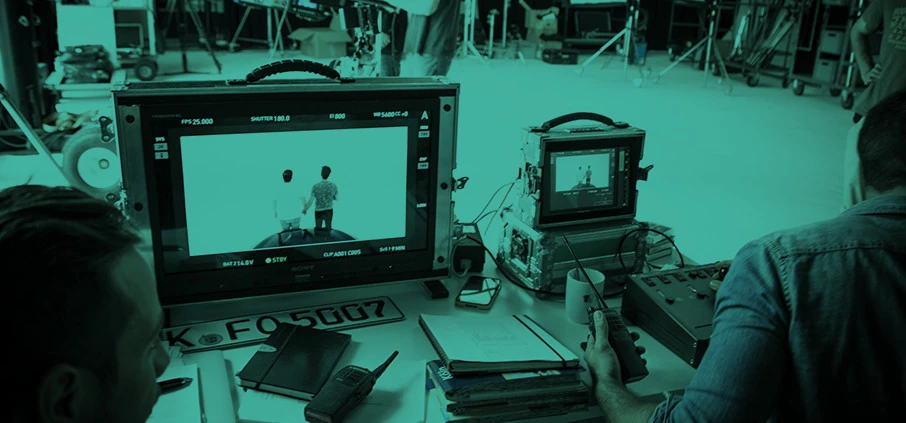
QLTY media consists of a core team in Cologne and a network of freelancers for directing, editing, animation, 3D, and sound.
Frequently asked questions
Isn't a freelancer network riskier than an agency with permanent staff?
The GmbH is the contractual partner and carries the liability. If someone drops out, others from the network step in.
Which projects suit a network?
Creative work of almost any size, including multilingual and across several countries.
Sources
- WPP Annual Report 2025
- Reuters: Ad group WPP cuts outlook after big client losses, July 9, 2025
- Reuters: WPP plunges after new CEO starts with a profit warning, October 30, 2025
- Reuters: WPP's new CEO simplifies ad group to save 500 million pounds by 2028, February 26, 2026
- Reuters via Investing.com: WPP cutting up to 1,000 more jobs by year-end, September 1, 2026
- Wu, Wang, Evans: Large teams develop and small teams disrupt science and technology, Nature 566, 2019
- Upwork Future Workforce Index 2026
 Why marketers should watch the porn industry for tech trends
 Does AI Kill Creativity? What Two Studies Show
 AI in Marketing for Mid-Sized Companies: What Actually Works in 2026