




The question is no longer whether marketing needs AI. The question is where it saves time and where it adds work. That distinction belongs before the first licence.
What the figures actually say
The Bitkom study from March 2026 shows clear movement. 41 percent of the companies surveyed with 20 or more employees use artificial intelligence actively. A year earlier the figure was 17 percent. Another 48 percent plan to use it. 604 companies were surveyed.
That is a rapid rise. It says little about the benefit.
Of the companies already using AI, 52 percent report a measurable contribution to business success. 48 percent report no measurable contribution. That is the real finding: usage is not benefit. A company that adopts AI because everyone else does has one more tool and no advantage yet.
There is also an obligation many have not yet noted. Since August 2026 the transparency duties of the EU AI Act under Article 50 apply. AI-generated content must be labelled. This covers image, audio and video that appear deceptively real, and certain texts on matters of public interest. Those who handle this cleanly face no disadvantage. Those who ignore it do.
- Companies with active AI use
- 41 percent (Bitkom, March 2026)
- AI users with measurable success
- 52 percent (Bitkom, March 2026)
- Freelancers in the QLTY network
- more than 200
- Agency from Cologne, mid-sized and industrial clients
- since 2015
Where AI helps in marketing
AI saves time on tasks that repeat.
These are drafts first. An opening text, an outline, a rough cut for a campaign. The effort drops. The quality of these drafts stays invisible outside, because everything provisional gets reworked anyway.
These are variants. One motif in several formats, one text in several lengths, one title in several versions. These tasks repeat often and tie up working hours. They are easy to hand over.
These are translations and summaries. Long documents, transcripts, subtitles. This is where AI saves time that is otherwise scarce.
In all three cases the same rule applies: AI delivers the draft, a person checks and decides. Skipping the check saves in the wrong place.
Where AI does not help
AI does not replace strategic decisions. If it is unclear who a brand should address and why, AI only speeds up the wrong direction. It produces more material, not more clarity.
AI does not replace brand responsibility. Attitude, tone and positioning come from decisions, not from probabilities. A model can imitate a style. It cannot answer for it.
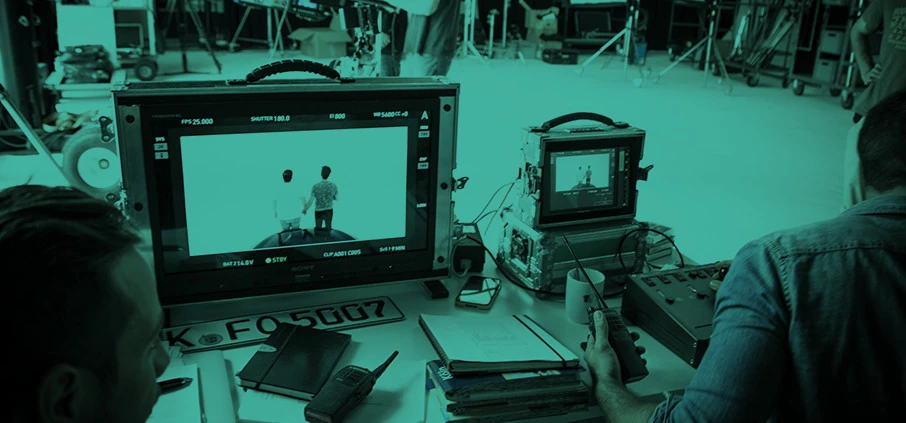
AI does not help with real material. A film that shows people needs people in front of the camera. A client project needs the real location, the real product, the real statement. Substitutes look good in preview and fail in use.
And without measurement the benefit remains unproven. Without a metric defined in advance, every rollout stays a feeling. The question at the end is the one from the beginning, at higher cost.
Usage is not benefit: AI saves time where work repeats. It does not decide where responsibility is required.
How to start with limited risk
The entry does not begin with a tool but with a field. One area, one task, one measurable goal. Not five projects at once.
A sensible field has high volume and low risk: translations, text variants, first drafts. There a mistake is correctable and the time saving shows quickly.
Before the start, define what success is measured by. Processing time, turnaround, number of versions. One metric is enough, measured including the review work. If it does not improve, the attempt is in question: the field, the tool or the way it is applied.
Then comes the prototype. Small, bounded, with real material from your own house. Only when it works is the budget for the rollout decided. Not the other way round.
QLTY media has worked in this order since 2015: prototype first, budget second. No quotes on the fly. The agency from Cologne serves mid-sized and industrial clients, among them Ford, DHL, Telekom, Bosch and DEVK, and draws on a network of more than 200 freelancers. Its fields are film, social media and AI content.
Free initial consultation: If you have a field in mind but no number for it yet, we check in a conversation whether it becomes a prototype. No quote on the fly, no budget before the first result.
Music check for campaigns AI labelling: what the EU Code of Practice regulates
 Is AI Training for Employees Mandatory?