
What does a product image cost?
It depends on the route you take. A studio image typically costs 7 to 100 euros per image according to marketplace figures, with custom photography at 80 to 250 euros per hour. A 3D visualisation runs between 150 and 800 euros per article at various providers. An image generator such as Midjourney costs 10 to 120 dollars per month, no matter how much you generate.
These prices come from providers and marketplaces, not from a neutral market report. They do show the order of magnitude in which the three routes move. The real difference is not the price per image, but what becomes possible afterwards.
| Criterion | Studio | 3D model | Generator |
|---|---|---|---|
| Typical cost | 7 to 100 euros per image | 150 to 800 euros per article | 10 to 120 dollars per month |
| Time to image | days to weeks | days to weeks | minutes |
| Variants | reshoot every one | cheap after setup | regenerate every one |
| Rotatable in browser | no | yes | no |
| Real material | yes | approximation | not reliable |
| Legal certainty | high | high | limited, see below |
When the 3D model wins
The 3D model wins when you need many images of one product: views, colour variants, installation scenes. After the initial build, every additional camera angle costs only render time. One provider charges around 80 euros per image for material variants once the model exists; another 150 to 800 euros depending on the material, matte, glass or chrome.
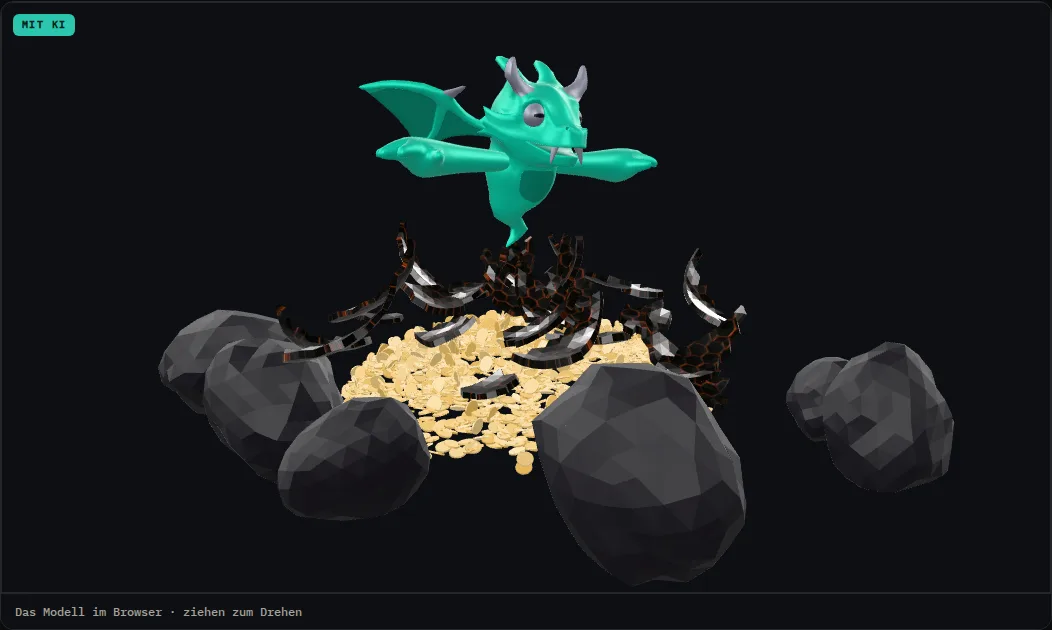
The dragon from our report on the dragon film is such a case. Modelled once in Blender, it can be rotated, lit and placed into any scene. The same dragon stands today as an interactive model in the browser and as a character in the film. A photograph cannot do that.
Blender itself costs nothing. The software is open source. The cost is working time: modelling, materials, lighting. After that, every variant comes cheap.
When the image generator wins
The generator wins for single images and moods: a background for a campaign, an illustration for a blog article, a moodboard. Midjourney costs between 10 dollars on the Basic plan and 120 dollars on the Mega plan per month, with a 20 percent discount on the annual subscription. Companies with more than 1 million dollars in annual revenue must book Pro or Mega, according to the provider.
The limit: generators do not deliver reliable products. They create the impression of a product, not the product. For packshots of a real article that is meant to be sold, that does not work. And anyone who wants to protect generated images against copycats is in a weak position: the Munich Local Court excluded three AI-generated logos from copyright protection in February 2026 because human creative input was missing. The ruling concerned logos, but the logic carries over to generated images: whoever does not design themselves does not own the result in the copyright sense.
When the studio wins
The studio wins when the real material is the message. Textiles, food, surfaces you have to see in order to buy. Photography captures reflections, translucency and texture that a 3D model only approximates and a generator invents. For the hero product of a campaign this is often the right choice.
Also when you need images that hold up legally: the studio delivers the photographer's work with full copyright protection.
How you decide
Three questions sort the choice. First: how many images do you need of this product? One to three points to the studio or the generator, a series to 3D. Second: must the product be exact, or the mood? Exact means studio or 3D, mood is enough for the generator. Third: will the product be needed again later, for catalogue, shop, animation? Then the 3D model pays off, even if the first image is more expensive.
We combine the routes. Generator for mood images, 3D for series and rotatable models, studio for material shots. One does not exclude the other.
Frequently asked questions about product images with AI
Who owns AI-generated product images?
Under a ruling of the Munich Local Court of 13 February 2026, purely AI-generated logos enjoy no copyright protection because human creative input is missing. Anyone using generated images commercially can hardly defend them against copycats in doubt. Your own, recognisably human post-processing can establish protection.
Does AI replace the product photographer?
For series and standard packshots, work shifts towards 3D. For material, textures and the hero product, the studio stays. Photography is not dying, it concentrates on what only it can do.
When is the generator worth it at all?
When mood matters more than exactness: backgrounds, illustrations, moodboards, drafts. From 10 dollars per month the barrier to testing is low. For sold products it does not work as the only channel.
What does the first step cost?
A consultation with us costs nothing. We tell you which route is right for your product and show the prototype including costs before you commission anything.
Sources: Listando (marketplace figures for product photography, 2026) · Freedes Studio (provider figures for 3D rendering, 2026) · Maverick Frame (provider figures for 3D visualisation, June 2026) · Midjourney (plan overview, accessed October 2026) · Blender (download page, open source) · Munich Local Court (judgment of 13 February 2026, case no. 142 C 9786/25)
 Suno-Urteil: Was das GEMA-Urteil für KI-Musik bedeutet
 KI-Marketing mit Zahlen: die Bitkom-Studie 2026