

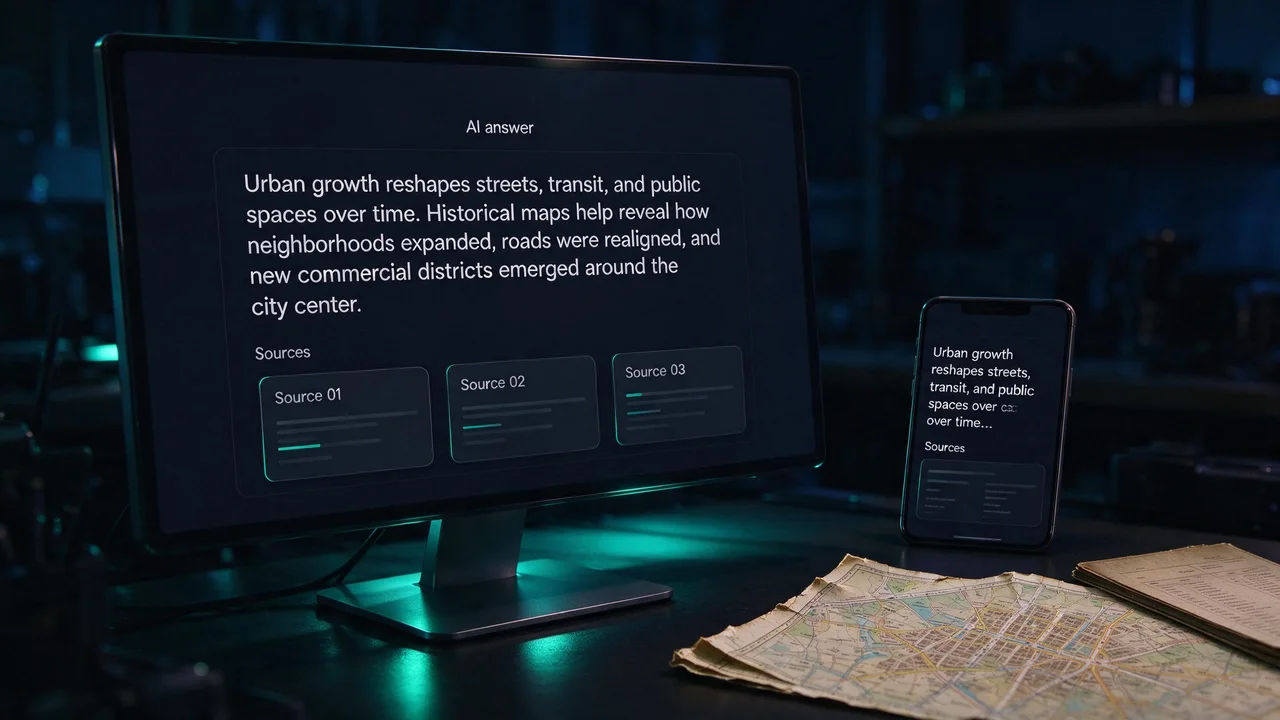
Google is adding AI answers to search. Instead of a list of links, users increasingly see a summary at the top of the results page, with links to sources. For companies this raises a new question: do we appear in these answers, and what does that yield? This article summarises the available studies and describes the steps we have taken on our own website.
What has changed since AI Overviews?
The AI summaries above the results list are called AI Overviews and have existed since May 2024. AI Mode, a separate search mode for longer answers and follow-up questions, was expanded by Google to more than 180 countries in August 2025, initially in English (Google, August 2025). In May 2026 Google connected both functions worldwide into one flow: a query can start with an overview and continue as a conversation in AI Mode. According to Google, more than one billion people use AI Mode every month; the number of queries has more than doubled every quarter since its introduction (Google I/O 2026).
Two analyses describe what this does to clicks. Two figures come from a BrightEdge analysis, one from a study by the Pew Research Center:
- Impressions and click rate
- BrightEdge reported in May 2025 that, for the search data examined, impressions had risen by more than 49 percent while the click rate had fallen by almost 30 percent since May 2024 (BrightEdge, May 2025). Whether this resulted in fewer clicks overall does not follow from these two figures: more impressions can offset a lower click rate.
- Click behaviour
- Pew examined the Google searches of 900 US adults in March 2025 (Pew Research Center, July 2025). On visits with an AI summary, users clicked a classic result in 8 percent of cases; without a summary, in 15 percent. Links inside the summary were clicked in 1 percent of visits with a summary.
- What this means
- Some queries are presumably already answered on the results page, so the visit to the underlying website never happens. This applies to the US users studied; the data does not allow transfer to all markets and services.
For companies, the question is shifting. It used to be: do we rank at the top of the results list? Now it also includes: are we mentioned or linked in the answer?
Where do the sources in AI answers come from?
For Google, the information comes from the Google search index. An indexed page can be considered as a source; its selection for a specific answer is not guaranteed. Which sources actually appear can be seen from usage data: in the Pew sample, Wikipedia, YouTube and Reddit were the platforms listed most often, together 15 percent of the sources recorded (Pew, July 2025).
The length of the query also plays a role. In the Pew study, a query of ten words or more produced an AI summary in 53 percent of cases; one- or two-word queries in 8 percent. Longer queries therefore lead to AI answers more often.
For content, this means: those who know their customers' questions can turn them into headings and answers. There is no guarantee of appearing in AI answers.
What does the analysis of links and mentions show?
An Ahrefs study of 75,000 brands (published May 2025) measured which factors occur together with mentions in AI Overviews. Note: the sample was pre-filtered. Brands with no AI Overview mention at all were excluded from the further analysis. The findings therefore transfer only partly to companies that are currently invisible.
- Brand mentions on the web
- 0.664. The strongest correlation measured in the analysis.
- Brand anchors
- 0.527. Links whose link text carries the brand name.
- Brand search volume
- 0.392. The estimated number of searches for the brand name.
- Number of backlinks
- 0.218. The weakest of the four measured values.
These are correlations, not proof of effect. The analysis does not show which measure most improves the AI visibility of an individual company. What remains readable: mentions of a brand outside its own website correlated more closely with AI Overview mentions than the pure number of backlinks. A linked brand mention, however, is both at once; the categories overlap.
What we do on our website
So far we have no measurement results of our own. These steps are implemented:
- Four languages
- German, English, Japanese, Farsi. Freely accessible, no login, no consent wall. Whether these language versions reach relevant audiences remains to be evaluated.
- Crawler access
- Our robots.txt blocks no search crawler, including those of AI providers. A crawl, however, proves neither inclusion in an index nor use in an answer.
- Sitemap
- Submitted in the Google Search Console. This makes URLs easier to find; whether they are indexed we check there separately.
- Bot log
- A daily job analyses our server logs and records which search robots retrieve the pages. This too is a technical finding, not proof of visibility in answers.
- Answers early in the text
- Reader question as heading, the core statement in the first sentences, verifiable claims with source and date. Google does not prescribe a special AI writing style; we still find this format clearer.
Frequently asked questions about AI search
Do you need an llms.txt file?
For Google Search: no. Google states in its AI optimisation guide (Search Central) that such files neither improve nor harm visibility there. A sitemap serves a different purpose independently of this: helping search engines find URLs.
What is the difference between AI Overviews and AI Mode?
AI Overviews are the summary at the top of the results list. AI Mode is Google's search mode for longer AI answers and follow-up questions. Since May 2026 both can be used without leaving the search context: an overview can turn into a conversation.
Is classic SEO still worth it?
Yes. Google's AI answers draw on the Google search index. Technical accessibility, indexing and helpful content remain the foundation. Google itself puts it this way: optimising for AI search is still SEO.
Where do I start?
With strategy, not technology. First define at which customer questions and in which search services your company should be visible. Then record your current visibility. Then check technical and content gaps: robots.txt, sitemap, content that actually answers the customer questions. Finally, examine which trade media, partners and industry platforms your audience uses and where your expertise offers a plausible reason for a mention.
How do you measure visibility in AI answers?
For Google, the generative AI reports in the Search Console have shown impressions and affected URLs from AI answers worldwide since the end of August 2026 (Google, June 2026), but no complete answer texts. For other services there is no generally recognised measure. We work with documented samples: search service, question, language, region and date recorded, brand mentions, recommendations and source links counted separately.
Costs before commission
We first examine which customer questions are relevant for your company in AI search and what visibility there would cost. You decide afterwards.
Free initial consultation What AI Video Costs in 2026: A 20-Dollar Subscription vs. Agency Prices
 AI Music: 300 Versions Until the Right Song